

A New Foreign Service Act: What Does This Mean?
By: Dan Spokojny | June 25, 2026
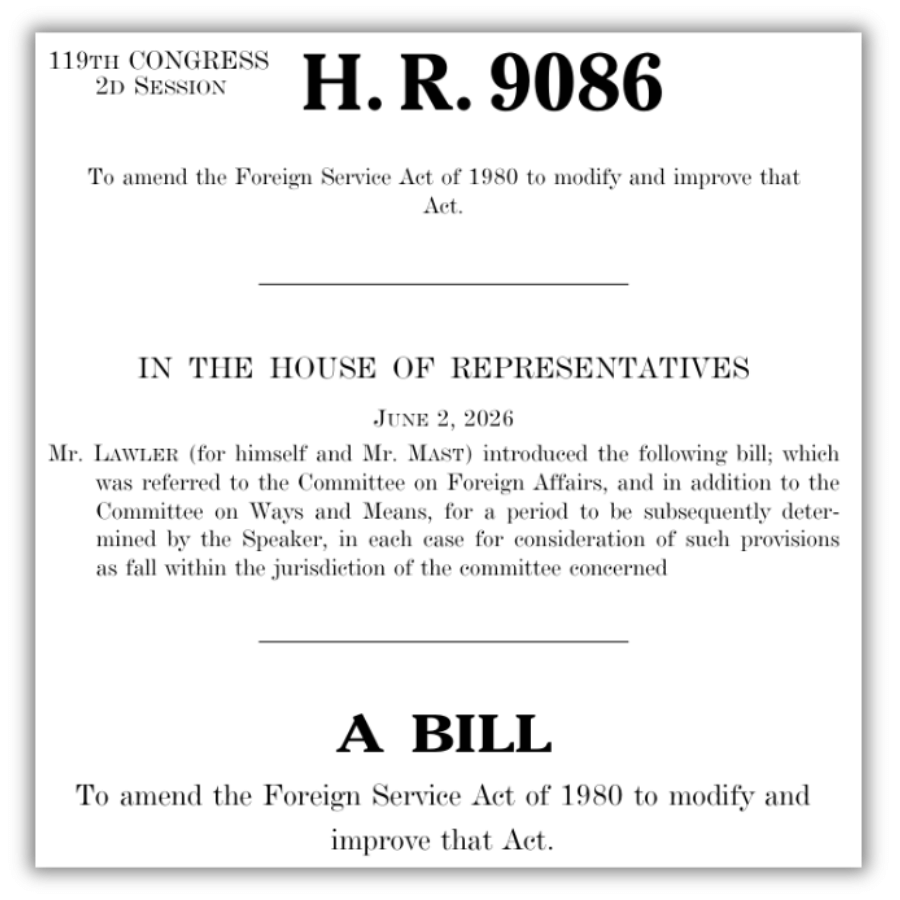
The House Foreign Affairs Committee has been on a roll with State Department-related reauthorizations. On June 2, 2026, Chairman Brian Mast and Subcommittee Chair Mike Lawler introduced what will be the first meaningful reauthorization of the Foreign Service Act since 1980. It was marked up and passed by the full committee shortly after with (gasp!) bipartisan support. Here’s the link to the full draft legislation.
My overall take is that the bill is constructive. Nothing in this bill aims for deep structural change, and both supporters and critics of the Foreign Service might have desired more creative challenges to the status quo. Nevertheless, it is commendable that HFAC is following through on its responsibilities to regular reauthorizations. The bill will still need to make its way through the full House and Senate approval and signature into law, so there may be substantive additional changes throughout the process. But here’s where the legislation stands for now, along with a bit of my own analysis:
The legislation calls for a Tiger Team to be established at the State Department to develop a plan to improve the capability and willingness for expeditionary diplomacy. The report will be due in two years. I see this as a positive initiative, especially in contrast to the unhelpful politics that surrounded the 2012 Benghazi attacks. It may be politically helpful that this report will be completed during a Republican administration. That said, this issue has been thoroughly studied, and one might have hoped that HFAC could have simply legislated changes now rather than further postponing the legislative work. Nevertheless, this is an important step.
The legislation establishes a Diplomatic Reserve Corps Pilot Program. This program will test a surge capacity mechanism that can recruit retired and former officers back into operations during crises. This idea was drafted six years ago by the powerful former Undersecretary for Management, Patrick Kennedy, and has remained a priority for the American Academy of Diplomacy. I have written previously that it is unclear what lessons the Reserve Corps proposal learned from the defunct Civilian Response Corps. I hope this pilot goes well and provides a useful service to the Department.
Speaking of management issues, the legislation would codify that the Director General of the Foreign Service serves concurrently as Assistant Secretary for Human Resources. The DG position was designed as an institutional advocate for the Foreign Service, so dual-hatting this position seems more likely to disempower the Foreign Service; perhaps that is the goal.
Perhaps the most impactful proposal in the legislation is the addition of a joint-duty assignment requirement before promotion into the Senior Foreign Service. The logic seems to be that Senior Foreign Service officers are frequently called on to collaborate with other agencies, or even exercise Chief of Mission authority over them. While this requirement will be phased in over five years, I wonder about the workforce impact of many senior folks scrambling to exit the already short-staffed Department for external assignments. In principle, however, I like this idea. While time in training and on external assignments is typically seen as “not career-enhancing” for Foreign Service Officers, inserting this into promotion precepts means everyone will be on equal footing.
And, the legislation adds some career protections for members on external training, education, or details, preserving their rank, tenure clock, promotion eligibility, and right to a performance evaluation.
The legislation makes a small but notable tweak to qualifications for the Board of Examiners by striking “or training in the fields of testing” and inserting “academic study, background in diplomacy”. This seems like a good change, but the promotion process remains highly subjective. I have always been interested in a deeper study of how the State Department can and should measure merit.
At the same time, the bill directs the Secretary of State to convene an independent commission to review the structure, relevance, and effectiveness of the Foreign Service’s career tracks (formerly known as cones: Political, Economic, Public Diplomacy, Consular, and Management). It is hard to say where this could go, but it could be interesting.
The legislation directs the Department to author a new cybersecurity/technology governance framework for missions abroad, covering AI governance, hardware supply-chain security, and incident response. This seems smart.
The legislation encourages the appointment of knowledgeable and experienced officials, suggesting that “detailed knowledge and requisite experience formulating and executing United States foreign policy, including a working understanding of Department operations and procedures, is vital for chiefs of mission, Assistant Secretaries of State, and other senior officials at the Department…” It’s a nice thought, but the Senate already has confirmation authority over these senior positions, and inexperienced outsiders have been entering the Department at unprecedented rates, so...
The legislation also does a lot for Veterans. Most prominently, it creates a Foreign Service Pathway for Veterans Program that will pilot a streamlined hiring process to recruit veterans for Diplomatic Security, cybersecurity, and any other position deemed mission-critical. It seems like an easy win if we can find highly qualified applicants from the military. But many are concerned that veterans’ preferences have eroded meritocratic hiring principles: in our current hiring system, a long-serving veteran will typically beat out a civilian with far more relevant expertise. There are some hazards in fast-tracking veterans rather than reforming the hiring process more holistically.
Adds additional training requirements across a range of issues, including: antisemitism/Holocaust distortion, AUKUS partnership coordination, international narcotics/law enforcement, foreign online scam syndicates, defense cooperation authorities for chiefs of mission, cybersecurity/AI, crisis leadership, and consular issues.
Requires timely transmission of tenure/promotion lists to the President for Senate confirmation, with reporting if deadlines are missed.
Adds detailed anti-nepotism and transparency rules for recruiting public members of Foreign Service selection boards, including conflict-of-interest disclosure, documentation of “word-of-mouth” referrals, and recordkeeping.
Adds legislative-branch experience (e.g., congressional fellowships) as a qualifying credential for promotion.
Addresses tax residency treatment for Foreign Service Officers posted abroad.